

Buy Mini Concrete Batching Plant
As an equipment professional who has worked with overseas SMEs for many years, I've seen too many purchasing misconceptions: Many clients compare base prices from various suppliers when buy mini concrete batching plants, choosing the lowest-priced one, only to find after delivery that construction, installation, logistics, and spare parts add up at every stage, resulting in a total expenditure far exceeding expectations. In fact, for mini concrete plants in the 25-60 m3/h capacity range, the base price typically only accounts for 65%-75% of the total cost of the entire lifecycle. The remaining hidden costs are the key to determining true cost-effectiveness.
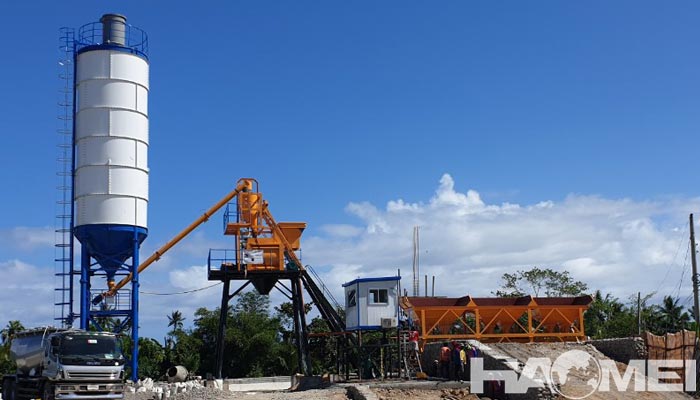
Construction and installation costs are the most easily underestimated first hidden expense. The difference in construction costs between different configurations of mini concrete batching plants can be as much as double. The hopper-type vertical feeder has a compact structure. Taking the HZS35 concrete batching plant as an example, when using a hardened floor, foundation-free solution, the civil engineering investment is only about 40% of that of a belt conveyor with the same capacity and a standard foundation. If a reinforced concrete foundation is chosen, the civil engineering cost can account for 10%-15% of the bare machine price. Installation costs also vary significantly: For standard export models with a modular pre-assembly rate of over 80%, on-site commissioning can be completed in 5-7 days; for lower-priced models shipped in parts, the installation cycle can be as long as 12-15 days. In overseas markets where labor costs are high, the difference in installation labor costs alone can be 2-3 times, and the project delays caused by work stoppages are even more difficult to estimate.
Logistics and customs clearance costs are the core hidden barriers to cross-border procurement. For overseas customers, this expenditure can typically reach 20%-30% of the value of the goods. The core difference lies in the modular disassembly capability of the equipment. Regular export-oriented mini concrete plant equipment stations can be disassembled and adapted to standard 40HQ containers; a single HZS50 concrete batching plant requires only two standard containers for shipment. Non-standardized models often exceed size limits, requiring bulk carrier transport, resulting in overall freight costs exceeding 30%. More critically, certification compliance is paramount: equipment lacking CE or other corresponding regional certifications may face customs seizure, fines, or even return shipments. Demurrage fees and penalties alone can reach 20% of the cargo value, a major pitfall for unqualified, low-priced equipment manufacturers.
Operational maintenance and spare parts costs are the core determinants of long-term expenses. Many low-priced equipments rely on non-standard parts to reduce initial costs, leading to extremely high subsequent maintenance costs. For example, wear-prone parts like main unit liners and mixing blades can be sourced globally using standard high-manganese steel, while non-standard customized parts cost more than twice as much and can only be purchased from the original manufacturer, with delivery times exceeding one month. For projects with tight schedules, a single day of downtime can result in losses of thousands of dollars, far exceeding the price difference of the spare parts themselves. In terms of energy consumption, mini concrete batching plant equipment with the same production capacity but different configurations can have a power consumption difference of 1-2 kWh per cubic meter of concrete. Based on an annual production of 10,000 cubic meters, this difference in annual electricity costs can reach tens of thousands of US dollars. Over five years, the accumulated expenditure far exceeds the initial purchase price difference of several thousand US dollars.
Throughout my years in the industry, I've always held the view that the core of buy mini concrete batching plant is controlling the total cost, not just the bare machine price. When the budget is limited, prioritize streamlining non-core features. Never compromise on the three core components: the main unit, metering, and certification—the former saves a small one-time expense, while the latter fills a large long-term hole.
Ultimately, the competition in purchasing mini concrete batching plants is never about who offers the lowest price, but about who has more control over the entire lifecycle cost. Only by including hidden costs such as civil engineering, logistics, and operation and maintenance in the budget, and then comparing complete solutions from different manufacturers, can you truly select high-performance equipment and avoid the dilemma of "buying cheap but using expensive."
Construction and installation costs are the most easily underestimated first hidden expense. The difference in construction costs between different configurations of mini concrete batching plants can be as much as double. The hopper-type vertical feeder has a compact structure. Taking the HZS35 concrete batching plant as an example, when using a hardened floor, foundation-free solution, the civil engineering investment is only about 40% of that of a belt conveyor with the same capacity and a standard foundation. If a reinforced concrete foundation is chosen, the civil engineering cost can account for 10%-15% of the bare machine price. Installation costs also vary significantly: For standard export models with a modular pre-assembly rate of over 80%, on-site commissioning can be completed in 5-7 days; for lower-priced models shipped in parts, the installation cycle can be as long as 12-15 days. In overseas markets where labor costs are high, the difference in installation labor costs alone can be 2-3 times, and the project delays caused by work stoppages are even more difficult to estimate.
Logistics and customs clearance costs are the core hidden barriers to cross-border procurement. For overseas customers, this expenditure can typically reach 20%-30% of the value of the goods. The core difference lies in the modular disassembly capability of the equipment. Regular export-oriented mini concrete plant equipment stations can be disassembled and adapted to standard 40HQ containers; a single HZS50 concrete batching plant requires only two standard containers for shipment. Non-standardized models often exceed size limits, requiring bulk carrier transport, resulting in overall freight costs exceeding 30%. More critically, certification compliance is paramount: equipment lacking CE or other corresponding regional certifications may face customs seizure, fines, or even return shipments. Demurrage fees and penalties alone can reach 20% of the cargo value, a major pitfall for unqualified, low-priced equipment manufacturers.
Operational maintenance and spare parts costs are the core determinants of long-term expenses. Many low-priced equipments rely on non-standard parts to reduce initial costs, leading to extremely high subsequent maintenance costs. For example, wear-prone parts like main unit liners and mixing blades can be sourced globally using standard high-manganese steel, while non-standard customized parts cost more than twice as much and can only be purchased from the original manufacturer, with delivery times exceeding one month. For projects with tight schedules, a single day of downtime can result in losses of thousands of dollars, far exceeding the price difference of the spare parts themselves. In terms of energy consumption, mini concrete batching plant equipment with the same production capacity but different configurations can have a power consumption difference of 1-2 kWh per cubic meter of concrete. Based on an annual production of 10,000 cubic meters, this difference in annual electricity costs can reach tens of thousands of US dollars. Over five years, the accumulated expenditure far exceeds the initial purchase price difference of several thousand US dollars.
Throughout my years in the industry, I've always held the view that the core of buy mini concrete batching plant is controlling the total cost, not just the bare machine price. When the budget is limited, prioritize streamlining non-core features. Never compromise on the three core components: the main unit, metering, and certification—the former saves a small one-time expense, while the latter fills a large long-term hole.
Ultimately, the competition in purchasing mini concrete batching plants is never about who offers the lowest price, but about who has more control over the entire lifecycle cost. Only by including hidden costs such as civil engineering, logistics, and operation and maintenance in the budget, and then comparing complete solutions from different manufacturers, can you truly select high-performance equipment and avoid the dilemma of "buying cheap but using expensive."

Inquiry
| (Please write down the product model or any requirement) | |
| E-mail: | |
| Message: | |
Contact Information
E-mail:chris@concretebatchplant24.com
Tel: +86-371-65621392
Fax:+86-371-86616825
Add : No.14 Waihuan Road,New strict,Zhengzhou,China