

China Mini Batching Plants
As the product manager responsible for exporting small and medium-sized concrete batching plants at Haomei Machinery, I have interacted with nearly two hundred overseas clients involved in small and medium-sized projects over the past 10 years. A clear trend is emerging: more and more township contractors and small building material operators are no longer clinging to established European and American equipment, but instead choosing China mini batching plants in the 25-60 m3/h range. This is not simply a price compromise, but rather a result of the systematic advantages that Chinese mini batching plants have developed in three dimensions: investment efficiency, scenario adaptability, and operational barriers, precisely addressing the real pain points of global small and medium-sized infrastructure projects.
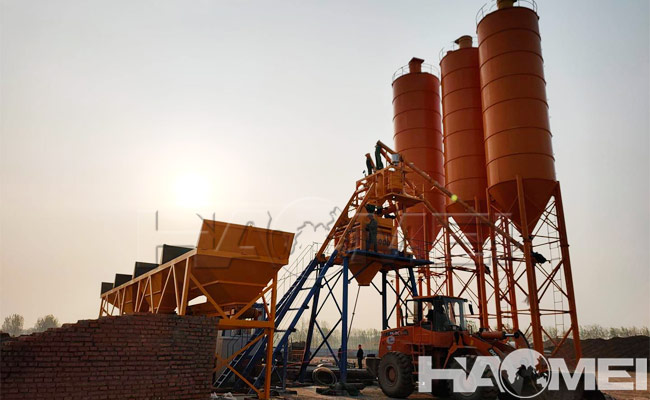
The first advantage is an extreme return on investment without compromising performance. Many people mistakenly believe that the low price of Chinese equipment is due to reduced features, but in reality, it is the efficiency dividend brought by mature industrial clusters. Relying on the well-developed construction machinery industry chain in the Central Plains and Yangtze River Delta regions, the localization rate of core components exceeds 75%, and large-scale mass production significantly reduces manufacturing costs. For the same production capacity, the purchase price of mini concrete batching plants in China is only 45%-55% of that of similar brands in Europe and America, but the core performance is not compromised: all models come standard with a JS series twin-shaft forced-action main unit, an independent electronic weighing and metering system, aggregate error ≤±2%, powder and liquid material error ≤±1%, fully complying with EN 206 international concrete standards, and capable of stably producing C10-C50 grade concrete. Based on a 5-year usage cycle, including energy consumption, wear parts, and labor costs, the total lifecycle cost of Chinese mini batching plants is only about 40% of that of European and American models. The investment payback period can generally be controlled within 1.5-2 years, far lower than the 4-5 years level of European and American brands, making it extremely friendly to small and medium-sized operators with limited budgets.
The second advantage is the ultimate adaptability to complex scenarios. Overseas small and medium-sized projects generally face problems such as irregular sites, complex terrain, and weak civil engineering conditions, making standardized European and American models often unsuitable for local conditions. Mini concrete batching plants in China generally adopt a highly modular design. The hopper-type configuration occupies approximately 30% less floor space than European and American models with the same production capacity. For example, the HZS35 concrete batching plant occupies only about 50 square meters, making it suitable for installation in small urban construction sites, mountainous mining areas, and idle land in towns and villages. Most models support hardened ground surfaces, eliminating the need for a foundation, reducing civil engineering costs by more than 60% compared to traditional fixed systems. The components are perfectly compatible with standard container transportation, allowing for on-site installation and commissioning in 5-7 days. Some mobile concrete batching plants can even produce materials in 2-3 days, shortening the deployment cycle by nearly two-thirds compared to the modular equipment of Europe and America. This strong adaptability allows it to penetrate into lower-tier markets that large-scale concrete mixing plants cannot reach.
The third advantage is the low maintenance threshold adaptable to less technologically advanced conditions. Remote regions generally lack skilled technicians, and the maintenance of complex equipment has always been a challenge for the industry. China mini batching plants are designed with this in mind: their core structure is streamlined and reliable, with over 30% fewer moving parts than comparable European and American models, resulting in a lower annual failure rate; the operating interface supports multiple languages, with intuitive and clear logic, allowing ordinary workers to operate independently after 3-5 days of training; core wear parts adopt internationally standardized specifications, with wide procurement channels, eliminating reliance on original manufacturer-customized parts. Combined with remote technical support and rapid parts delivery services provided by manufacturers, stable equipment operation can be guaranteed even in remote areas of Africa and Southeast Asia.
Essentially, the success of China mini batching plants lies not in low-end, low-price offerings, but in their mature industrial capabilities precisely matching the needs of global small and medium-sized infrastructure projects. For customers, it is not a "second-best" option, but rather the solution with the highest overall return at the current stage.
The first advantage is an extreme return on investment without compromising performance. Many people mistakenly believe that the low price of Chinese equipment is due to reduced features, but in reality, it is the efficiency dividend brought by mature industrial clusters. Relying on the well-developed construction machinery industry chain in the Central Plains and Yangtze River Delta regions, the localization rate of core components exceeds 75%, and large-scale mass production significantly reduces manufacturing costs. For the same production capacity, the purchase price of mini concrete batching plants in China is only 45%-55% of that of similar brands in Europe and America, but the core performance is not compromised: all models come standard with a JS series twin-shaft forced-action main unit, an independent electronic weighing and metering system, aggregate error ≤±2%, powder and liquid material error ≤±1%, fully complying with EN 206 international concrete standards, and capable of stably producing C10-C50 grade concrete. Based on a 5-year usage cycle, including energy consumption, wear parts, and labor costs, the total lifecycle cost of Chinese mini batching plants is only about 40% of that of European and American models. The investment payback period can generally be controlled within 1.5-2 years, far lower than the 4-5 years level of European and American brands, making it extremely friendly to small and medium-sized operators with limited budgets.
The second advantage is the ultimate adaptability to complex scenarios. Overseas small and medium-sized projects generally face problems such as irregular sites, complex terrain, and weak civil engineering conditions, making standardized European and American models often unsuitable for local conditions. Mini concrete batching plants in China generally adopt a highly modular design. The hopper-type configuration occupies approximately 30% less floor space than European and American models with the same production capacity. For example, the HZS35 concrete batching plant occupies only about 50 square meters, making it suitable for installation in small urban construction sites, mountainous mining areas, and idle land in towns and villages. Most models support hardened ground surfaces, eliminating the need for a foundation, reducing civil engineering costs by more than 60% compared to traditional fixed systems. The components are perfectly compatible with standard container transportation, allowing for on-site installation and commissioning in 5-7 days. Some mobile concrete batching plants can even produce materials in 2-3 days, shortening the deployment cycle by nearly two-thirds compared to the modular equipment of Europe and America. This strong adaptability allows it to penetrate into lower-tier markets that large-scale concrete mixing plants cannot reach.
The third advantage is the low maintenance threshold adaptable to less technologically advanced conditions. Remote regions generally lack skilled technicians, and the maintenance of complex equipment has always been a challenge for the industry. China mini batching plants are designed with this in mind: their core structure is streamlined and reliable, with over 30% fewer moving parts than comparable European and American models, resulting in a lower annual failure rate; the operating interface supports multiple languages, with intuitive and clear logic, allowing ordinary workers to operate independently after 3-5 days of training; core wear parts adopt internationally standardized specifications, with wide procurement channels, eliminating reliance on original manufacturer-customized parts. Combined with remote technical support and rapid parts delivery services provided by manufacturers, stable equipment operation can be guaranteed even in remote areas of Africa and Southeast Asia.
Essentially, the success of China mini batching plants lies not in low-end, low-price offerings, but in their mature industrial capabilities precisely matching the needs of global small and medium-sized infrastructure projects. For customers, it is not a "second-best" option, but rather the solution with the highest overall return at the current stage.

Inquiry
| (Please write down the product model or any requirement) | |
| E-mail: | |
| Message: | |
Contact Information
E-mail:chris@concretebatchplant24.com
Tel: +86-371-65621392
Fax:+86-371-86616825
Add : No.14 Waihuan Road,New strict,Zhengzhou,China