

How To Choose A Mobile Concrete Batching Plant?
With over a decade of experience in exporting concrete batching equipment and working with numerous overseas clients, I have observed that many buyers focus on only a single metric when selecting a mobile concrete batching plant—often leading to either excess, underutilized capacity or an insufficient supply. To choose the right mobile concrete batching plant, you must evaluate your project’s specific requirements across four dimensions: capacity matching, structural configuration, core components, and operational/after-sales suitability.
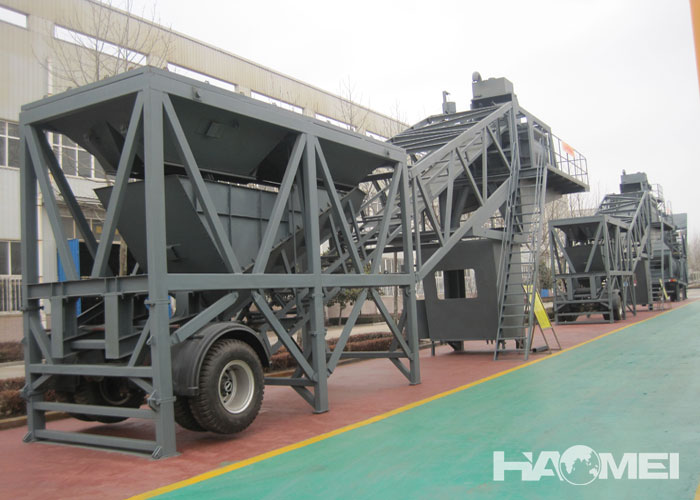
Capacity matching is the fundamental basis for selection. The "theoretical capacity" stated for any piece of equipment represents its peak output under ideal conditions; in practice, the stable, continuous operating capacity is typically 70%–80% of this figure. When determining the required capacity, calculate your average daily concrete demand, divide it by the daily operating hours, and then add a 10%–15% buffer to arrive at the necessary theoretical capacity. For small-scale repairs or emergency projects with a daily demand of up to 100 m³, the YHZS25 mobile concrete batching plant—featuring a 25 m³/h theoretical capacity and a JS500 twin-shaft mixer—is a suitable choice, capable of producing up to 200 m³ per single shift. For rural infrastructure or municipal projects with a daily demand of around 200 m³, the YHZS35 mobile concrete batching plant (35 m³/h theoretical capacity) is appropriate. Medium-sized projects requiring 300–400 m³ per day are well-served by the YHZS50 to YHZS60 mobile concrete batching plant, while for medium-scale, continuous construction operations, the YHZS90 mobile batching plant—with a theoretical capacity of 90 m³/h—is the ideal solution. For a rural road project in East Africa, the initial plan was to procure a YHZS60 concrete batching plant. However, following an assessment of the stable daily demand—calculated at 280m³—a YHZS50 mobile concrete batching plant was selected instead. This choice fully met the construction pace while reducing equipment investment costs by 12%.
The structural configuration should be determined based on the frequency of relocation and site conditions. For linear infrastructure projects characterized by dispersed work sites, short durations, and frequent relocations, a trailer-mounted (integrated chassis) design is preferred. Such units offer high integration, allowing for relocation without the need to disassemble core components, and can be towed on public roads at speeds of 40–50 km/h. These units require no poured concrete foundation; they are leveled using four hydraulic outriggers with a 300mm adjustment range, capable of accommodating site slopes of up to ±12°, and can be operational within 12–24 hours. For projects with a duration exceeding six months at a fixed location, a modular mobile concrete batching plant is a better choice, offering lower procurement costs and greater stability for continuous, long-term operation.
Pay close attention to weighing accuracy and the core mixing configuration, as these factors directly determine the quality of the finished concrete. In accordance with the national standard, the permissible weighing deviation is ±2% for aggregates and ±1% for cement, water, and admixtures; ensure that the selected equipment can consistently meet these precision standards. For the main mixer, a twin-shaft forced-action design is recommended due to its superior mixing uniformity and versatility with various materials. Opting for high-manganese steel liners and mixing blades—which offer a service life of at least 80,000 batches under normal operating conditions—can significantly reduce future costs associated with replacing wear parts.
Finally, consider the specific operating environment to determine necessary customizations and the level of after-sales support. For overseas projects, local climatic conditions must be taken into account: in extremely cold regions, the equipment should include oil-circuit preheating and aggregate bin insulation; in hot, sandy, or dusty environments, it should feature fully enclosed dust-proof designs and forced-cooling systems; and for coastal projects, the entire unit should be treated with anti-corrosive coatings. Additionally, verify the standardization (interchangeability) rate of core components; a higher rate ensures greater convenience when sourcing spare parts in the future. The Haomei YHZS series mobile concrete batching plant features a component commonality rate of over 92%. With spare parts warehouses established across Southeast Asia, Africa, and the Middle East—and the capability to provide technical responses within 48 hours in key regions—Haomei significantly reduces the operational and maintenance challenges for overseas projects.
In general, the selection of a mobile concrete batching plant should be based on a comprehensive assessment of specific project requirements. Haomei Machinery offers free selection guidance and detailed technical specifications tailored to your project’s volume, site conditions, and operational environment. Please feel free to contact our sales team for technical documentation on specific models or to request an price quote.

Inquiry
| (Please write down the product model or any requirement) | |
| E-mail: | |
| Message: | |
Contact Information
E-mail:chris@concretebatchplant24.com
Tel: +86-371-65621392
Fax:+86-371-86616825
Add : No.14 Waihuan Road,New strict,Zhengzhou,China