

4 Cubic Meter Self Loading Mobile Concrete Mixer
Among the full range of self loading concrete mixer equipment, the 4 cubic meter model, while not the largest capacity model, has become the mainstream choice for medium-sized infrastructure projects due to its precise adaptability to various working conditions. Its core value lies in breaking the capacity paradox of "insufficient capacity for small models and limited space for large models." Through system-level matching of the power system, mixing mechanism, chassis load-bearing capacity, and mobility, 4 cubic meter self loading mobile concrete mixer achieves an optimal balance between capacity efficiency, site accessibility, and overall cost. It's a cost-effective solution for scenarios such as rural contiguous construction, municipal road renovation, and factory floor pouring.
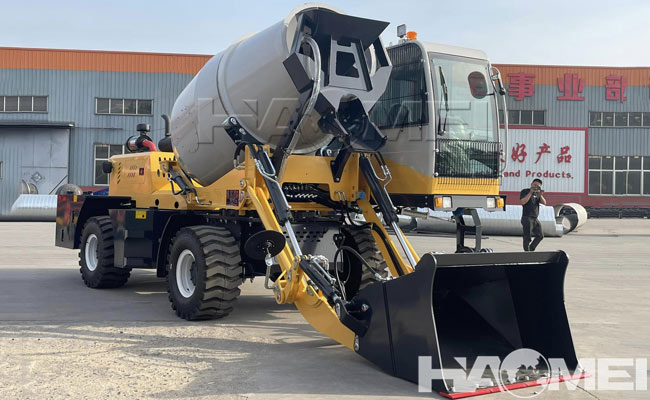
From a capacity design perspective, 4 cubic meters refers to the effective discharge volume, corresponding to a mixing drum geometric volume of approximately 6 cubic meters. The volume utilization rate is controlled at around 67%, a ratio verified through engineering practice. This ensures sufficient output per drum while reserving ample space for material tumbling, avoiding the risks of overflow and segregation. Based on standard operating cycle calculations, the complete cycle from feeding, mixing to unloading of a single tank takes approximately 10-12 minutes, with a theoretical hourly capacity of 16-20 cubic meters. A continuous 8-hour operation daily capacity is stable between 120-160 cubic meters, perfectly covering the daily pouring needs of most medium-sized projects. This avoids equipment idleness due to overcapacity and eliminates the need for frequent multi-tank scheduling.
The power and chassis systems are optimized for complex construction site scenarios. The 4 cubic meter self loading concrete mixer is equipped with a Yuchai YC4108 series turbocharged diesel engine with a rated power of 91-95kW and ample torque reserves. Power is distributed to the travel, hydraulic, and mixing systems via a power take-off. The chassis adopts a 4×4 all-wheel-drive engineering off-road architecture, equipped with large-tread engineering tires and heavy-duty axles. Under full load, its maximum climbing ability reaches 30°, easily handling unpaved mountain roads, muddy construction sites, and foundation pit ramps. The machine has a curb weight of approximately 8.5 tons, a wheelbase controlled between 2.6 and 2.8 meters, and a minimum turning radius of 4.5 meters. This allows for flexible maneuverability in confined spaces such as urban streets and factory areas, a mobility advantage rarely found in larger machines with a capacity of 6.5 cubic meters or more.
The precision design of the mixing and metering system ensures the engineering-grade quality of the finished concrete. The mixing drum employs a double-helix continuous blade structure, maintaining a stable rotation speed of 18-21 rpm during mixing. Through a combination of axial pushing and circumferential tumbling motion, it achieves thorough convection and shearing of aggregates, cement, and water. At room temperature, C30 grade concrete can achieve homogeneity requirements within a standard mixing time of 90 seconds, with a slump deviation controlled within 20 mm. The independent metering system weighs and monitors the flow rate of sand, gravel, cement, and water, with a comprehensive mix proportion error of ≤±1.5%. Combined with real-time parameter feedback on the digital display screen in the cab, it can produce stable strength finished concrete with quality approaching commercial concrete plant standards without relying on operator experience.
The unloading and relocation functions further amplify the adaptability of self loading mobile concrete mixer. The cylinder is equipped with a 270°horizontal rotation mechanism, coupled with hydraulic pitch adjustment, allowing for an unloading height of 1.8-2.0 meters. This covers pouring points on three sides of the vehicle without requiring the entire vehicle to move, making it particularly suitable for long-line operations such as trench backfilling and roadbed pouring. The equipment also features a mobile mixing function; during relocation, the cylinder maintains a low-speed mixing speed of 2-3 revolutions per minute, preventing initial setting segregation during short-distance transport and achieving seamless integration of "production-transfer-pouring".
Comprehensive calculations show that a 4-cubic-meter self-loading mobile concrete mixer requires only one operator, replacing the traditional combination of one loader, one stationary mixer, and 4-5 support personnel, reducing the overall cost per cubic meter of concrete by more than 30%. For projects of moderate size, scattered locations, and without nearby commercial concrete plants, the 4-cubic-meter model, with its balanced performance, is the optimal choice, balancing efficiency, cost, and adaptability.
From a capacity design perspective, 4 cubic meters refers to the effective discharge volume, corresponding to a mixing drum geometric volume of approximately 6 cubic meters. The volume utilization rate is controlled at around 67%, a ratio verified through engineering practice. This ensures sufficient output per drum while reserving ample space for material tumbling, avoiding the risks of overflow and segregation. Based on standard operating cycle calculations, the complete cycle from feeding, mixing to unloading of a single tank takes approximately 10-12 minutes, with a theoretical hourly capacity of 16-20 cubic meters. A continuous 8-hour operation daily capacity is stable between 120-160 cubic meters, perfectly covering the daily pouring needs of most medium-sized projects. This avoids equipment idleness due to overcapacity and eliminates the need for frequent multi-tank scheduling.
The power and chassis systems are optimized for complex construction site scenarios. The 4 cubic meter self loading concrete mixer is equipped with a Yuchai YC4108 series turbocharged diesel engine with a rated power of 91-95kW and ample torque reserves. Power is distributed to the travel, hydraulic, and mixing systems via a power take-off. The chassis adopts a 4×4 all-wheel-drive engineering off-road architecture, equipped with large-tread engineering tires and heavy-duty axles. Under full load, its maximum climbing ability reaches 30°, easily handling unpaved mountain roads, muddy construction sites, and foundation pit ramps. The machine has a curb weight of approximately 8.5 tons, a wheelbase controlled between 2.6 and 2.8 meters, and a minimum turning radius of 4.5 meters. This allows for flexible maneuverability in confined spaces such as urban streets and factory areas, a mobility advantage rarely found in larger machines with a capacity of 6.5 cubic meters or more.
The precision design of the mixing and metering system ensures the engineering-grade quality of the finished concrete. The mixing drum employs a double-helix continuous blade structure, maintaining a stable rotation speed of 18-21 rpm during mixing. Through a combination of axial pushing and circumferential tumbling motion, it achieves thorough convection and shearing of aggregates, cement, and water. At room temperature, C30 grade concrete can achieve homogeneity requirements within a standard mixing time of 90 seconds, with a slump deviation controlled within 20 mm. The independent metering system weighs and monitors the flow rate of sand, gravel, cement, and water, with a comprehensive mix proportion error of ≤±1.5%. Combined with real-time parameter feedback on the digital display screen in the cab, it can produce stable strength finished concrete with quality approaching commercial concrete plant standards without relying on operator experience.
The unloading and relocation functions further amplify the adaptability of self loading mobile concrete mixer. The cylinder is equipped with a 270°horizontal rotation mechanism, coupled with hydraulic pitch adjustment, allowing for an unloading height of 1.8-2.0 meters. This covers pouring points on three sides of the vehicle without requiring the entire vehicle to move, making it particularly suitable for long-line operations such as trench backfilling and roadbed pouring. The equipment also features a mobile mixing function; during relocation, the cylinder maintains a low-speed mixing speed of 2-3 revolutions per minute, preventing initial setting segregation during short-distance transport and achieving seamless integration of "production-transfer-pouring".
Comprehensive calculations show that a 4-cubic-meter self-loading mobile concrete mixer requires only one operator, replacing the traditional combination of one loader, one stationary mixer, and 4-5 support personnel, reducing the overall cost per cubic meter of concrete by more than 30%. For projects of moderate size, scattered locations, and without nearby commercial concrete plants, the 4-cubic-meter model, with its balanced performance, is the optimal choice, balancing efficiency, cost, and adaptability.

Inquiry
| (Please write down the product model or any requirement) | |
| E-mail: | |
| Message: | |
Contact Information
E-mail:chris@concretebatchplant24.com
Tel: +86-371-65621392
Fax:+86-371-86616825
Add : No.14 Waihuan Road,New strict,Zhengzhou,China