

How To Buy Mini Mobile Concrete Plant?
With over a decade of experience in the export of concrete batching equipment, I have worked with numerous overseas clients. Many have encountered issues—such as mismatched production capacity, inadequate configurations, or a lack of after-sales support—simply because their initial evaluation criteria were too narrow. Buy mini mobile concrete plant involves more than just comparing price quotes; it requires a thorough assessment of four core dimensions—production capacity, configuration, structural design, and service—to ensure you select equipment that offers the best fit and value for your specific project needs.
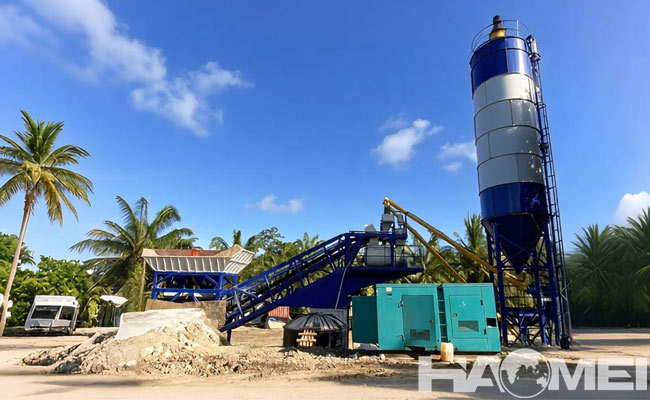
Matching production capacity is the primary prerequisite for procurement. Begin by calculating your project’s daily concrete demand and determining the required hourly output based on the effective daily operating hours. It is important to note that the "theoretical capacity" stated by manufacturers represents a peak value under ideal conditions; in actual, continuous operation, the stable output is typically 70%–80% of this figure. Therefore, it is advisable to include a 10%–15% capacity buffer when selecting your equipment. For small-scale repairs or emergency projects with a daily demand of up to 150 m3, a 25 m3/h model is suitable. For rural infrastructure or municipal projects requiring 200–250 m3 per day, a 35 m3/h model is appropriate. For medium-sized projects with a daily demand of 300–400 m3, consider a 50–60 m3/h model. A West African client once initially opted for a high-capacity mobile concrete plant model without careful assessment, resulting in an equipment idle rate exceeding 40%. After switching to a more appropriately sized model, their equipment investment for the project was reduced by 28%.
Core components directly determine both the mobile concrete plant equipment's service life and the quality of the finished product. For the main mixer, prioritize a twin-shaft forced-mixing design; ensure that the lining plates and mixing blades are made of high-manganese, wear-resistant material—capable of handling at least 80,000 batches under normal operating conditions and accommodating crushed stone aggregates with a particle size of up to 60mm. The weighing system must comply with the GB/T 10171-2016 standard: dynamic weighing deviation for aggregates should be ≤±2%, while the deviation for cement, water, and admixtures should be ≤±1%. An independent, multi-stage weighing architecture is preferred to ensure consistent mix proportions. The control system should support the storage of multiple mix designs, automatic production data recording, and self-diagnostic functions; it should also offer customizable, multi-language interfaces to suit the operational preferences of international personnel.
The structural configuration should align with the specific site conditions and the frequency of relocation. For linear infrastructure projects requiring frequent moves, an integrated, trailer-mounted chassis is ideal—capable of being towed on roads at speeds of 40–50 km/h. The chassis should feature hydraulic outriggers with a 300mm adjustment range, allowing the unit to adapt to site slopes of up to ±12° without the need for a poured concrete foundation, enabling production to begin within 12–24 hours. For urban redevelopment or mountainous projects with limited space, a compact vertical-layout model is recommended, as it reduces the horizontal footprint by over 30% for the same production capacity. Additionally, ensure that the equipment can be disassembled to fit into standard shipping containers, thereby lowering cross-border logistics costs.
A mobile concrete plant manufacturer’s supply and service capabilities dictate long-term operating costs. Prioritize suppliers with extensive export experience and ensure the equipment holds necessary certifications (such as the CE mark) for your target market. Furthermore, verify that at least 90% of the core components are standardized, making it easier to source replacement parts locally. It is also essential to evaluate the manufacturer’s overseas support infrastructure—such as the availability of local spare parts warehouses and the responsiveness of their remote technical support—to prevent long wait times for parts in the event of a breakdown, which could otherwise lead to costly project delays.
Haomei Machinery has specialized in the export of mobile concrete batching plants for over a decade. Our YHZS series offers a full capacity range from 25 to 90 m3/h, with transparent, verifiable equipment specifications. We have established a network of spare parts warehouses across Southeast Asia, Africa, and the Middle East, and we provide 24/7 remote technical support alongside on-site installation and training services. Please feel free to contact our overseas sales team to receive a customized equipment selection plan for your project, detailed technical specifications and quote.

Inquiry
| (Please write down the product model or any requirement) | |
| E-mail: | |
| Message: | |
Contact Information
E-mail:chris@concretebatchplant24.com
Tel: +86-371-65621392
Fax:+86-371-86616825
Add : No.14 Waihuan Road,New strict,Zhengzhou,China