

How Does Self Loading Concrete Mixer Work?
Self loading concrete mixers are essentially mobile closed-loop concrete production systems integrated into an engineering chassis. Their core working principle is the high integration of five functional units from a fixed concrete mixing plant: aggregate feeding, powder storage and transportation, precise metering, forced mixing, and finished product unloading. Through hydraulic transmission and electronic control systems, they achieve sequential coordination, completing the entire process of production from raw materials such as sand, gravel, and cement to finished concrete on a single unit, without relying on external sites or auxiliary equipment.
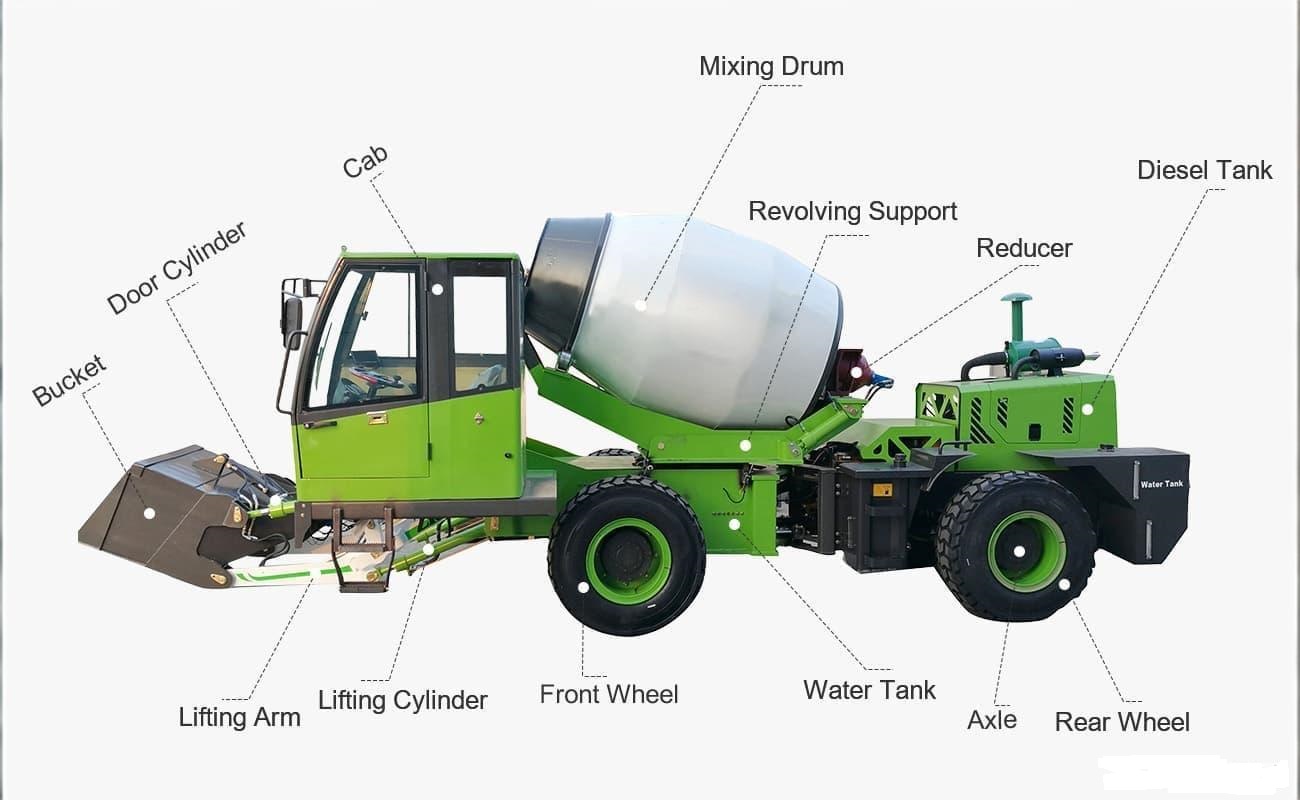
The feeding and metering system is the core of the entire equipment's infeed end, following the working logic of "time-based feeding and independent metering." The hydraulic loading bucket at the front of the self loading concrete mixer is driven by a lifting cylinder and a tilting cylinder, using an angle sensor to position the feeding stroke, completing the automatic cycle of ground scooping, lifting and feeding, and lowering back to reset. The metering module employs a multi-channel independent sensing scheme: aggregate weighing is dynamically achieved through resistance strain gauge load cells mounted on the bucket supports; cement and other powder materials are conveyed to the built-in powder silo via a screw conveyor and weighed separately by a weighing module at the bottom of the silo; water and admixtures are precisely controlled using electromagnetic flow sensors. After the system presets the mixing parameters, it can automatically perform multi-material weighing deductions and compensations, with the overall metering error controlled within ±1%. The feeding sequence follows the principle of "aggregate first, powder in the middle, water simultaneously," adding a portion of aggregate as a base, then adding cement and mixing water, and finally replenishing the remaining aggregate. This effectively reduces powder adhesion to the walls and improves mixing uniformity.
The mixing drum is the core mixing unit, relying on double helical blades to achieve forced convection mixing. The drum is internally arranged with two continuous helical blades, with a helix angle typically between 15° and 20°. During forward rotation, the blades cause the material to tumble circumferentially along the drum wall while simultaneously generating axial reciprocating motion, creating cross-convection and shearing effects to achieve thorough mixing of aggregates, powders, and water. Under mixing conditions, the drum speed remains stable at 12-14 rpm, with a standard mixing time of 90 seconds for C30 concrete at room temperature. During short-distance transfers, the speed drops to 2-3 rpm, maintaining only low-speed agitation to prevent concrete segregation and initial setting. During unloading, the drum rotates in the opposite direction, and the blades gradually push the material towards the discharge port; combined with the increased speed, this accelerates the unloading process. This structure ensures both mixing uniformity and meets the requirements for preventing segregation during transport and efficient unloading. The concrete homogeneity meets engineering standards, and the slump deviation can be controlled within 20mm.
The hydraulic transmission system is the power link of the entire self loading concrete mixer equipment, employing a "single power input, multi-circuit distribution" working mode. The diesel engine outputs power to the hydraulic main pump via a power take-off (PTO), which then distributes oil to actuators such as bucket lifting, mixing drum drive, unloading slewing, and travel steering. Mainstream models employ a load-sensitive hydraulic system, automatically adjusting output flow and pressure based on the real-time load of each actuator. The system's rated operating pressure is 16-20 MPa, reducing energy loss by approximately 15% compared to traditional fixed-displacement systems. This power distribution mechanism allows the equipment to seamlessly switch between different operating conditions such as travel, loading, mixing, and unloading without requiring an external power source, ensuring independent operation in environments without electricity.
A standard production cycle includes four core stages: bucket loading and metering, material mixing, drum mixing, and unloading. The entire process is uniformly scheduled by the electronic control system. For example, during the loading stage, the mixing drum pre-rotates at low speed; during the mixing stage, hydraulic flow is prioritized for the mixing motor; and during the unloading stage, the slewing mechanism and drum reverse synchronously. A single tank has a standard cycle time of approximately 10 minutes, and small-to-medium capacity models can achieve a daily continuous production capacity of over 150 cubic meters. It is this highly integrated system collaboration principle that allows self loading concrete mixer to overcome the site limitations of fixed concrete mixing plants and become a core solution for concrete construction in decentralized and remote scenarios.

Inquiry
| (Please write down the product model or any requirement) | |
| E-mail: | |
| Message: | |
Contact Information
E-mail:chris@concretebatchplant24.com
Tel: +86-371-65621392
Fax:+86-371-86616825
Add : No.14 Waihuan Road,New strict,Zhengzhou,China