

How Many Operators Does Self-Loading Concrete Mixer Need?
Over the years of promoting self-loading concrete mixers in overseas markets, the question I hear most often from customers is: "Exactly how many people are needed to operate this machine?" The answer is clear-cut: only one operator is required under standard working conditions. This is not merely a simplified marketing claim but a hard specification dictated by the equipment's integrated design. A single driver—having undergone just 3–5 days of training—can sit in the cab and execute the entire workflow, from scooping and loading materials, weighing and batching, and mixing, to rotating and discharging the concrete; no ground-based assistant is needed at any stage.
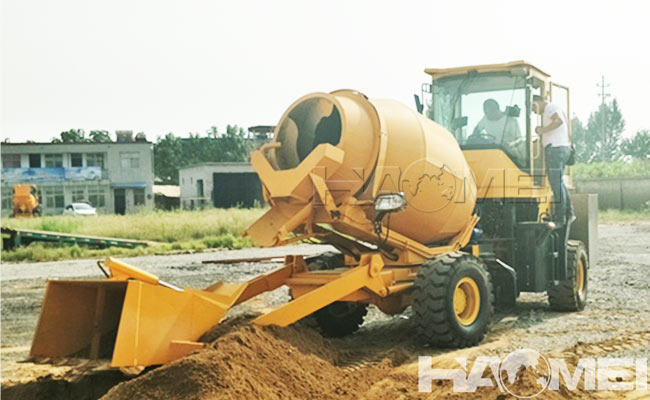
To understand how one-person operation is possible, one must first recognize the structural differences between the self-loading concrete mixer and traditional construction methods. Conventional on-site concrete production typically requires a four-person team: a wheel loader operator for scooping and transporting materials; a worker for handling and weighing bagged cement; a worker to control the mixer's start/stop functions; and another worker to maneuver the discharge chute. The self-loading concrete mixer integrates all these functions into a single vehicle: a front-mounted hydraulic bucket replaces the wheel loader for loading; an onboard weighing system replaces manual weighing; electronic controls in the cab replace the mixer's control console; and a 270-degree rotating discharge mechanism eliminates the need for a ground-based chute operator. This high level of functional integration directly reduces manpower requirements.
Regarding the specific operational workflow, the single driver’s tasks are highly streamlined and concentrated. Once the vehicle is positioned, the driver sets the concrete grade and mix ratio parameters via the control panel, and the system automatically selects the preset formula. The driver then shifts into forward gear to scoop up sand and gravel; the lifting cylinder automatically handles the material loading, while load cells on the bucket mount provide real-time feedback on aggregate weight. Cement screw conveyors and water valves are automatically controlled by the PLC, keeping metering errors within ±1%. The mixing drum operates automatically at the set speed and duration—standard mixing for C30 concrete takes 90 seconds. Finally, the driver uses the rotation handle to swivel the unit 270 degrees for discharge, utilizing the reversing camera to monitor the alignment between the discharge chute and the pouring point. Throughout this entire cycle, the driver remains in the cab with hands and feet on the controls, completing the process as a one-person, closed-loop operation.
In terms of labor costs, the economic efficiency of a single-operator setup is significant. Taking overseas markets like Southeast Asia and Africa as examples, the monthly wage for a qualified equipment operator is approximately $300–$500, whereas a traditional four-person crew incurs monthly labor costs of $1,200–$2,000. Switching to a self-loading concretge mixer reduces monthly labor expenditure per unit to just $300–$500—a direct monthly saving of $900–$1,500. On an annual basis, this saves $11,000–$18,000, equivalent to 20%–30% of the equipment's purchase price. For a 4-cubic-meter model with a daily capacity of 120 cubic meters, the labor cost per cubic meter drops from the traditional $10–$15 range to $2.5–$4—a reduction of over 70%.
Staffing requirements remain identical across models of different capacities. The operational logic for the compact 1.8 cubic meter model and the large 6.5 cubic meter model is the same—both are controlled by a single operator in the cab. While bucket lifting force, mixing power, and slewing torque scale up with the tonnage, there is no need for additional ground support personnel as capacity increases. Some customers initially worry that a single operator might be overwhelmed by simultaneously driving and managing the mixing process. However, in actual operation, a complete cycle takes about 10 minutes, with a mixing/waiting period of roughly 1.5 minutes; the operator can use this interval to check fluid levels or clear residue from the discharge chute, maintaining a manageable pace.
Labor savings offered by self-loading concrete mixers go beyond simply hiring fewer people; fundamentally, the technology replaces traditional division-of-labor workflows with integrated automation, enabling a single, well-trained individual to match the output of an entire crew. For small and medium-sized contractors, this translates to reduced management complexity, greater flexibility in personnel scheduling, and the ability to maintain stable production capacity even in regions facing labor shortages.
To understand how one-person operation is possible, one must first recognize the structural differences between the self-loading concrete mixer and traditional construction methods. Conventional on-site concrete production typically requires a four-person team: a wheel loader operator for scooping and transporting materials; a worker for handling and weighing bagged cement; a worker to control the mixer's start/stop functions; and another worker to maneuver the discharge chute. The self-loading concrete mixer integrates all these functions into a single vehicle: a front-mounted hydraulic bucket replaces the wheel loader for loading; an onboard weighing system replaces manual weighing; electronic controls in the cab replace the mixer's control console; and a 270-degree rotating discharge mechanism eliminates the need for a ground-based chute operator. This high level of functional integration directly reduces manpower requirements.
Regarding the specific operational workflow, the single driver’s tasks are highly streamlined and concentrated. Once the vehicle is positioned, the driver sets the concrete grade and mix ratio parameters via the control panel, and the system automatically selects the preset formula. The driver then shifts into forward gear to scoop up sand and gravel; the lifting cylinder automatically handles the material loading, while load cells on the bucket mount provide real-time feedback on aggregate weight. Cement screw conveyors and water valves are automatically controlled by the PLC, keeping metering errors within ±1%. The mixing drum operates automatically at the set speed and duration—standard mixing for C30 concrete takes 90 seconds. Finally, the driver uses the rotation handle to swivel the unit 270 degrees for discharge, utilizing the reversing camera to monitor the alignment between the discharge chute and the pouring point. Throughout this entire cycle, the driver remains in the cab with hands and feet on the controls, completing the process as a one-person, closed-loop operation.
In terms of labor costs, the economic efficiency of a single-operator setup is significant. Taking overseas markets like Southeast Asia and Africa as examples, the monthly wage for a qualified equipment operator is approximately $300–$500, whereas a traditional four-person crew incurs monthly labor costs of $1,200–$2,000. Switching to a self-loading concretge mixer reduces monthly labor expenditure per unit to just $300–$500—a direct monthly saving of $900–$1,500. On an annual basis, this saves $11,000–$18,000, equivalent to 20%–30% of the equipment's purchase price. For a 4-cubic-meter model with a daily capacity of 120 cubic meters, the labor cost per cubic meter drops from the traditional $10–$15 range to $2.5–$4—a reduction of over 70%.
Staffing requirements remain identical across models of different capacities. The operational logic for the compact 1.8 cubic meter model and the large 6.5 cubic meter model is the same—both are controlled by a single operator in the cab. While bucket lifting force, mixing power, and slewing torque scale up with the tonnage, there is no need for additional ground support personnel as capacity increases. Some customers initially worry that a single operator might be overwhelmed by simultaneously driving and managing the mixing process. However, in actual operation, a complete cycle takes about 10 minutes, with a mixing/waiting period of roughly 1.5 minutes; the operator can use this interval to check fluid levels or clear residue from the discharge chute, maintaining a manageable pace.
Labor savings offered by self-loading concrete mixers go beyond simply hiring fewer people; fundamentally, the technology replaces traditional division-of-labor workflows with integrated automation, enabling a single, well-trained individual to match the output of an entire crew. For small and medium-sized contractors, this translates to reduced management complexity, greater flexibility in personnel scheduling, and the ability to maintain stable production capacity even in regions facing labor shortages.

Inquiry
| (Please write down the product model or any requirement) | |
| E-mail: | |
| Message: | |
Contact Information
E-mail:chris@concretebatchplant24.com
Tel: +86-371-65621392
Fax:+86-371-86616825
Add : No.14 Waihuan Road,New strict,Zhengzhou,China