

Differences Between Self Loading Concrete Mixer Trucks and C
In the construction machinery equipment system, both self loading concrete mixer trucks and concrete mixer trucks (concrete transit mixers) are equipped with rotating mixing drums, often leading to confusion. However, they differ fundamentally in their functional positioning, structural logic, and applicable scenarios, corresponding to different roles in the concrete supply chain: the "on-site production end" and the "long-haul transportation end," respectively.
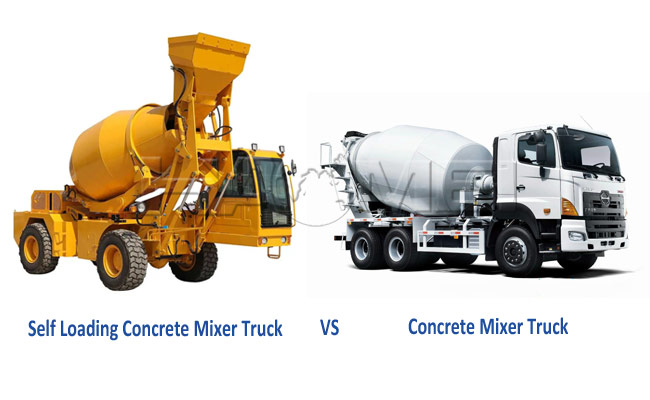
From a core functional perspective, a self loading concrete mixer truck is essentially a mobile mini concrete mixing plant, integrating five major functions: automatic feeding, precise metering, on-site mixing, short-distance transfer, and multi-angle unloading. It can independently complete the entire production process from raw materials such as sand, gravel, and cement to finished concrete, without relying on external mixing plants or loaders. Concrete mixer trucks, on the other hand, are essentially professional transport vehicles. Their mixing drums only serve a low-speed mixing function, primarily to prevent segregation and initial setting of concrete during transportation. They do not have the ability to independently batch and produce concrete and must load pre-mixed products from a fixed mixing plant before being put into use.
These differences in structural configuration directly determine the capability boundaries of the two. Self loading concrete mixer trucks integrate a hydraulic loading bucket and weighing system at the front, allowing direct scooping of on-site sand and gravel raw materials. Material mixing errors can be controlled within ±1%. The chassis are mostly engineering-specific off-road chassis, suitable for unpaved roads and steep slopes. Mixing capacity typically ranges from 1.8 to 6.5 cubic meters, with a single tank production cycle of approximately 10 minutes. Concrete mixer trucks, on the other hand, use heavy-duty truck chassis, suitable for high-speed highway driving. The nominal volume of the mixing drum is generally 8-12 cubic meters. During transportation, the drum speed is maintained at 1-3 rpm, increasing to 6-10 rpm during unloading. The entire process only involves agitation and homogenization, without completing the mixing of new materials.
The most significant difference between the two lies in their operating scenarios and applicable boundaries. The core advantage of self loading concrete mixer trucks lies in their scenario independence, making them particularly suitable for remote mountainous areas, rural infrastructure construction, and scattered municipal repairs—areas lacking fixed mixing plants. They are not limited by transportation radius, allowing for on-demand production and avoiding waste during initial concrete setting. Concrete mixer trucks are highly dependent on the layout of urban commercial concrete mixing plants. Constrained by the initial setting time of concrete, their typical effective transport radius is approximately 30 kilometers. The entire process from mixing with water to unloading must be completed within 90 minutes, with even stricter time requirements in high-temperature environments. They primarily serve large-scale urban construction projects and large-scale municipal engineering projects requiring concentrated pouring.
Their capacity efficiency and cost logic also differ. Self loading concrete mixer trucks have a smaller single-tank capacity but excel in continuous operation and immediate response, making them suitable for small-batch, multi-site, decentralized construction. They require only 1-2 operators, resulting in lower overall labor and material loss costs. Concrete mixer trucks have a large single-vehicle load capacity and high long-haul transport efficiency, suitable for large-scale continuous pouring. However, they require supporting mixing plants, dispatching systems, and a well-developed road network, leading to higher fixed investment and logistics scheduling costs. Their use in small, scattered projects can easily result in wasted transport capacity.
Overall, the two are not substitutes but rather complementary types of equipment within the concrete engineering system. They correspond to two different construction modes: decentralized on-site production and centralized batch transportation. The core selection depends on the project scale, site conditions, and surrounding supporting capabilities.

Inquiry
| (Please write down the product model or any requirement) | |
| E-mail: | |
| Message: | |
Contact Information
E-mail:chris@concretebatchplant24.com
Tel: +86-371-65621392
Fax:+86-371-86616825
Add : No.14 Waihuan Road,New strict,Zhengzhou,China